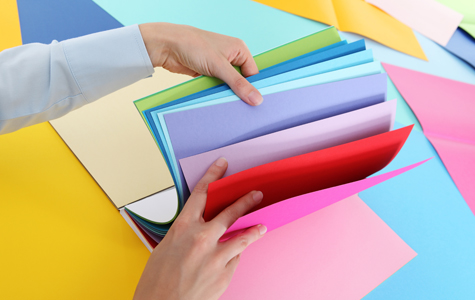
 The appearance of printing projects depends on the right combination of varied printing paper and customization options. However, knowing and choosing the best options may be challenging because there are so many options to choose from. Most buyers make mistakes because of the confusing multitude of paper types. Here, we will explain the available paper weight choices and how to tell the difference between each of them.
Choosing Your Printing Paper
To most consumers, paper is either flimsy or firm. Although, there are numbers and metrics used to signify the thickness and sturdiness of paper.
A good rule of thumb is: the greater the weight or point, the more sturdy and durable your material will be. Below are various paper weight units of measurement and their definition.
Paper Weight and Measurement Definitions
Since all manufacturers don’t use the same metric, our team at Clash created a quick reference for the most commonly used paper types, weights and measures.
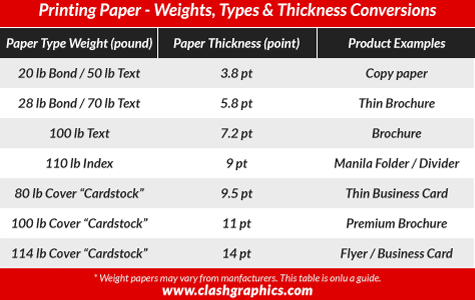 Learn this basic unit of paper weight measurement.
Pound – Distinguishes how many pounds 500 sheets of a specific paper grade weighs. Each respective paper grade has an industry standard size.
Point – Refers to the thickness of an individual sheet when measured with a device that measures micrometers, or thousands of an inch.
Below are the more popular paper weights.
Text – This paper can be referred to as “offset”, and has a wide range of uses.
Bond – Uncoated bond stock, often called “writing” paper, is most often used in office printer and copy machines.
Cover – These stocks are mostly rigid and not easily folded. Cover stock paper is frequently used on publication covers, business cards, folders and postcards
Paper Coating
Paper coating adds a tactile and visual appeal to printed materials. These coatings are flexible in their application. They can be used on the entire surface, or a certain part of the paper to highlight your logo or company mark for example.
UV Coating: (Ultra Violet): The solvent-free UV coating is a lustrous, glossy, very protective coating that provides a chemical and abrasive resistant hard finish. It may be used strategically to make a logo or picture stand out or used on an entire surface.
Aqueous: This water-based coating is thinner than UV coating. It protects surfaces from dirt, fingerprints, and scratches with its medium glossy finish. It is mostly used on brochures and postcards as well as business cards, protecting them through their journey in mails and deep pockets.
Paper Types
The right paper type can make your printing project really stand out. With choices ranging from gloss to dull, satin and matte, you can greatly improve the look of your project by simply selecting the right type. Get familiar which each type below:
Gloss – Just like a photograph, this appears as a glossy surface.
Satin – Coming halfway between gloss and matte, it enhances full-colour graphics even while preserving eligibility of the readable text. And it still looks shiny and attractive
Matte – This kind of finish is perfect for text-heavy documents. It appears smooth yet not as shiny as the other kinds of finish. It also removes fingerprints.
Uncoated – Stock that has not been coated with any sealant. UV or Aqueous coating cannot be applied to this type of paper.
Custom Printing Options That Stand Out
Your materials must be effective in conveying your message, but a unique finishing solution is a simple way to make your project more appealing to your audience. Below are some of the popular customizations you may choose to incorporate in your next project.
Embossing – Love to feel the designs and texts as you run your fingers over the paper? Using high pressure, embossing uses a specially-made die to create these impressions.
Metallic Ink – Using ink with fine reflective metallic particles create a look you won’t see around. To get that shiny and lustrous look, gold and silver are the go for.
Foil Stamping – By using heated die to stamp foil to paper, you can create design that shimmer and add texture to certain texts or graphics.
Die Cut – From straight out of the normal curves to perfect circles to the outline of imagines and company designs, die cutting helps create an infinite range of contours.
There are plenty of printing customization combinations. Knowing paper weight thickness, coating types, and finishing options will help ensure your next printing project is a success.
Clash Graphics Print Shop Atlanta Flyer Printing
2233 Peachtree Rd NE Ste 202 Atlanta, GA 30309
(678) 235-3464
To view the original version on Clash Graphics, visit: http://www.clashgraphics.com/printing-tips/printing-paper-weight-thickness-conversions-guide/

 People usually associate marketing of business with only online means like email marketing and blogging. However, there are equally effective ways of marketing businesses with the aid of tangible items such as printed banners. It is a perfect means of advertising if there is a large gathering. In this article, you will learn how to use a banner as a means of advertising in a festival, conference or trade show. Then contact
 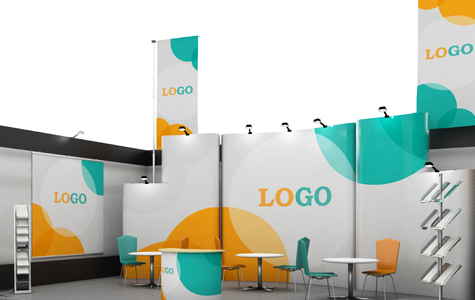 Ensure that your banner has its uniqueness so that it could catch the attention of the people. Since you have only a few seconds or minutes to catch the attention of the audience, it is important that the banner has a strong image and personality. In order to design an amazing banner, these are some of the questions you need to answer:
 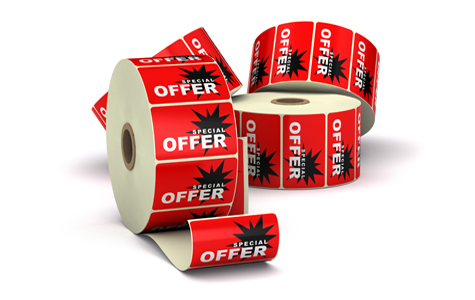 Stickers have always been a part of advertising campaigns thanks to their durability, affordability, and eye-catching nature. With the help of digital printing technology there are now endless possibilities when it comes to designing stickers. It’s also never been cheaper to order the finished design in bulk packages.
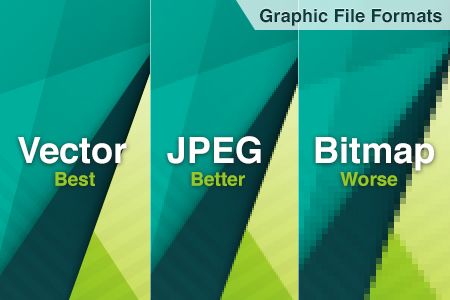 When you create a logo or business card design for a company, you’ll have the choice between using vector and JPEG or Bitmap graphics. You should always, always use vector graphics when you can for anything professional like a logo or printed material. Clarity and great quality at any size are two of the greatest benefits of the vector format. Though there are several other reasons and more to know about Vectors, JPEG, and Bitmap graphics. Our graphics and printing team
 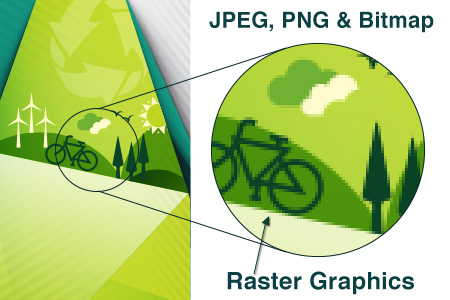 If you’ve ever tried to resize a jpeg then you know how dangerous and useless it is to do. Because it is a lossy compression format, once you expand a JPEG too far beyond its original dimensions, the image becomes very distorted and low quality. Thus, scaling JPEGs and BMPs leaves you with a broken image that is no good to anyone. This isn’t the case with vectors. Vectors are unique in that no matter how much you scale them, you won’t see any loss in clarity, appearance, or quality. You only have to design a vector image once and you can alter the size of it as much as you need. If you create a vector logo, you can later make it large for a banner, or small for a business card. It’s as easy as that.
 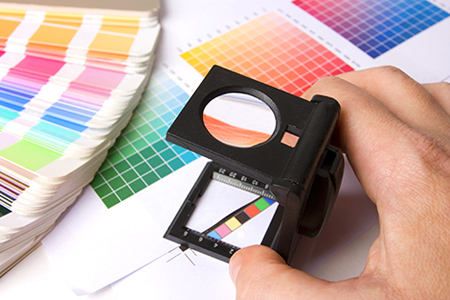 Pantone is, to put it simply, an American company that created an effective method of ensuring color match. Their name has become synonymous with this highly precise numbered color system. It’s so good, in fact, that it used in the majority of the printing companies throughout the industry. If you’re going to work in or with printing, then you need to be aware of Pantone colors and how you can benefit from it to ensure color match of your artwork, document and materials. Read this article to learn about using the Pantone system in printing or
 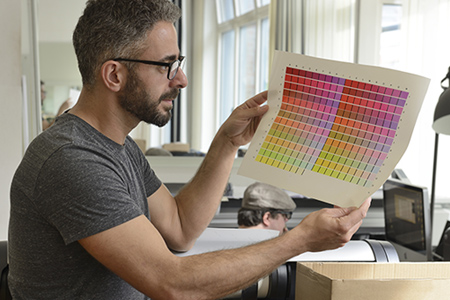 The Pantone system isn’t that difficult to use. You start by finding the exact color you want in the Pantone color palette and make a note of the number it is – ‘Red 199’ for example. If you’re the graphic designer commissioned by a client, you would then send a sample to the client so they can approve it. When you have their approval you create your artwork using this pantone color. Then send it off to a printer capable of utilizing the Pantone system.
 Document Bleed is a concept in the printing world whereby you deliberately leave an element of your artwork or design (usually a picture) spilling over the edges of the document beyond the trim edge. When a document is prepared with bleed, it’s printed on a larger sheet of printing paper and trimmed down to the exact size. It sounds silly to deliberately do something like that, but there are positive uses and a reason for doing this.
