In an era dominated by overflowing inboxes and endless digital notifications, physical mail has quietly become one of the most effective ways to capture attention. Direct mail marketing—the practice of sending printed materials like postcards, letters, and catalogs to targeted recipients—continues to deliver results that surprise marketers who dismissed it as outdated.
This guide breaks down everything you need to know about direct mail: what it is, why it works, how to execute campaigns that generate real returns, and how to integrate it with your digital marketing efforts.
Direct Mail Key Takeaways
Direct mail marketing is the practice of sending physical items—postcards, letters, catalogs, brochures, and other printed materials—to carefully selected mailing lists. The goal is to win new customers, nurture existing customers, and drive measurable actions like store visits, phone calls, or online purchases. Unlike fleeting digital ads, a direct mail piece can sit on a kitchen counter or desk for weeks, creating multiple opportunities for engagement.
Even in a highly digital world, direct mail still works remarkably well. Industry studies regularly show high open rates and response rates near 4–5%, far higher than most digital-only campaigns. These numbers explain why many marketers believe that direct mail delivers the best ROI of any marketing channel.
Modern direct mail is data-driven and integrated with digital channels. Marketers use segmentation, personalization, QR codes, and unique URLs to connect offline mail with websites, email marketing, and social media. This isn’t your grandfather’s junk mail; it’s highly targeted physical correspondence that complements your overall marketing strategy.
Costs can range anywhere from $0.30–$3 per piece, depending on format and volume, but strong targeting and tracking can produce very competitive ROI and a strong case for its cost-effectiveness as a marketing strategy.
Success comes from five pillars: clear strategy, accurate mailing lists, compelling creative and CTAs, smart timing, and consistent measurement and optimization.
What Is Direct Mail Marketing?
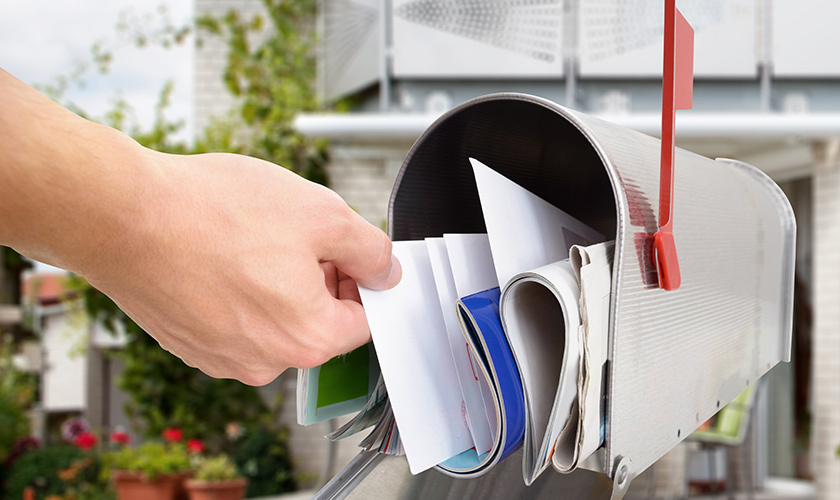
Direct mail marketing involves sending printed marketing materials through the postal service to homes or businesses to promote offers, generate leads, or build brand awareness. It’s physical material that lands in someone’s mailbox—something they can hold, read, and keep.
Here are practical examples of direct mail in action:
-
A home services company mails seasonal maintenance postcards to neighborhoods with older homes, offering “$50 off tune-ups” with a QR code for instant booking
-
A retail store sends personalized holiday catalogs to high-value customers, featuring items based on their browsing and purchase history
-
A nonprofit dispatches November donation letters with impact stories and matching gift calls to action
-
Credit card companies send pre-approved offer letters to prospects matching specific financial profiles
A typical direct mail piece always includes several core components: clear business identification (logo, company name, return address), a concise value proposition highlighting customer benefits, a prominent call to action telling the recipient exactly what to do next, and easy ways to respond—whether that’s a phone number, URL, QR code, or unique discount codes.
Unlike email or digital ads, direct mail is tangible. Recipients can hold it, stick it on the refrigerator, or leave it on their desk. Research indicates that physical mail stays in a household for more than a week, creating multiple touchpoints with your message. Physical mail creates a stronger emotional response and requires less cognitive effort to process than digital content.
Modern direct mail is rarely used alone. It normally supports wider strategies that also include email campaigns, SEO, paid search, Google Ads, and social media. The most effective campaigns use direct mail to drive recipients to digital channels where they can take immediate action.
Why Direct Mail Still Matters Today
Even in a digital-first world, physical mail continues to perform strongly. Consumers feel overloaded by online ads, notifications, and email—the average person receives over 100 emails daily, but only a handful of mail pieces. This digital noise creates an opportunity for businesses willing to use direct mail strategically.
The numbers tell the story: In 2023, direct mail spending in the United States reached almost $40 billion, with projections of generating over $10 billion in annual ad revenue by 2026. This continued investment signals that businesses across industries see direct mail delivering results.
Why does direct mail remain so effective? Several factors converge:
|
Factor |
Impact |
|---|---|
|
High open rates |
Direct mail has a higher open rate, with statistics indicating that 90% of direct mail gets opened compared to 20-30% of emails |
|
Strong response rates |
Average response rates for direct mail are around 4% to 5%, compared to less than 1% for email |
|
Trust advantage |
Most consumers report they trust print advertisements more than digital ones |
|
Longevity |
Direct mail can remain in a customer’s home or office for much longer than digital ads, increasing brand recall and perceived value |
Technology has actually strengthened direct mail rather than replacing it. Marketers now use automation, CRM integrations, variable data printing, and real-time analytics to improve targeting and measurement. Automated direct mail campaigns can be triggered by customer behaviors—like cart abandonment or warranty expiration—creating timely, relevant touches.
Main Advantages of Direct Mail Marketing
Direct mail’s advantages fall into four categories: attention and memorability, targeting and personalization, performance and ROI, and its ability to complement other marketing channels.
Cutting through digital noise: Physical mailers get noticed because they’re tangible. While someone might delete 50 emails without reading them, a well-designed postcard gets picked up, examined, and considered. Research shows the average person handles a mail piece 3-5 times before deciding on action. Direct mail marketing is perceived as more trustworthy, according to research on consumer behavior.
Precision targeting: Modern direct mail uses data-driven segmentation to target specific demographics and geographic locations. You can reach potential customers based on location, income, homeownership status, purchase history, or behavior patterns. Direct mail marketing allows for hyper-local targeting of specific neighborhoods or households—something digital advertising struggles to match at the local level.
Strong performance: Direct mail marketing often generates a significantly higher response rate than that of email marketing. When your list, offer, and timing align properly, these rates can climb even higher.
Omnichannel integration: Direct mail fits seamlessly into broader marketing campaigns. A postcard can drive someone to scan a QR code, visit a landing page, or redeem a code that then triggers email sequences or retargeting with digital ads.
Why Invest in Direct Mail Today?
Digital fatigue is real. Consumers delete emails in bulk and scroll past ads without registering them. Meanwhile, a direct mail piece is harder to ignore—it has physical presence and demands at least a moment of attention. This creates a lasting impression that fleeting digital ads rarely achieve.
There’s often less competition in the physical mailbox than in the inbox. The average household receives far fewer direct mailers than emails, which translates into higher visibility and stronger brand recall for each campaign you send. You’re not competing with hundreds of other messages for attention.
Modern data tools and CRMs allow precise segmentation. Effective targeting in direct mail marketing involves segmenting audiences based on demographics, geographic areas, and psychographic features to ensure that marketing materials are relevant to recipients. You can suppress uninterested groups, focus on high-intent audiences, and thereby improve ROI while reducing wasted resources.
Variable data printing takes personalization further. You can customize names, offers, images, and even maps or product recommendations for each recipient at scale. Personalized direct mail pieces indicate that a business appreciates its clients enough to provide them with a tailored experience, which strengthens the bond between the business and its customers. This personal touch distinguishes your mail from generic promotional pieces.
When paired with tracking tools—unique codes, dedicated phone numbers, custom URLs—direct mail becomes a measurable, testable channel rather than a blind branding tactic. You can fine-tune campaigns based on actual response data.
Types of Direct Mail (With Practical Uses)
Choosing the right format affects cost, impact, and how much information you can include. Smart marketers match format to campaign goals rather than defaulting to one type for everything.
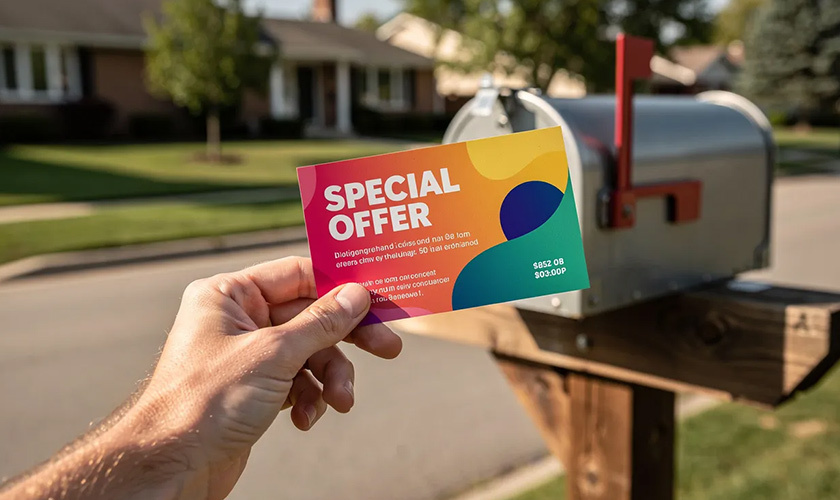
Postcards are the workhorses of direct mail. They’re ideal for quick promotions, appointment reminders, and local offers. Because there’s no envelope to open, postcards achieve near-100% visibility, and recipients see your message immediately. Average costs range from $0.30 to $0.80 per piece at volume. Direct mail postcards work well for local businesses running seasonal promotions or service reminders.
Letters in envelopes suit more detailed or sensitive messages. Financial offers, membership renewals, donation appeals, and contracts all benefit from the formality and perceived value of an envelope. Costs range from $0.80 to $1.50 per piece. The envelope itself can generate curiosity when designed well.
Self-mailers fold to create their own envelope, offering more space than postcards at a lower cost than traditional letters ($0.50–$1.20). They work for informational campaigns where you need to communicate in greater detail.
Catalogs and booklets showcase multiple products, seasonal collections, or gift guides. These are ideal for retailers and ecommerce brands ($1.50–$3.00+). While expensive, catalogs have long shelf lives and drive repeat engagement as customers browse them over time.
Oversized and dimensional mail (sometimes called “lumpy mail”) includes packages with samples, branded gifts, or unusual shapes. These formats can achieve up to 50% higher open rates and work exceptionally well for high-stakes B2B campaigns targeting decision-makers. The cost is higher, but so is the impact and ROI oftentimes.
How Direct Mail Works: From Idea to Mailbox
Understanding the full direct mail process helps you see how strategy, data, creative, production, and postal logistics fit together. Sending direct mail effectively requires coordination across multiple stages.
The main stages include:
-
Defining objectives
-
Building or refining the mailing list
-
Crafting the message and design
-
Printing and production
-
Mailing and delivery
-
Tracking responses
Businesses typically start by clarifying a goal—book 100 service appointments in Q3, re-activate lapsed customers, increase store traffic for a specific weekend event. Clear objectives guide every subsequent decision.
Audience selection draws from internal databases (existing or past customers) and external sources (purchased lists, look-alike audiences, neighborhood targeting by ZIP code or carrier route). Many companies now use marketing platforms or APIs to trigger mail automatically based on events, such as a customer abandoning a cart or a warranty approaching expiration.
Step 1: Define Audience and Objectives
Clear goals and a tightly defined target audience are the foundation of any effective direct mail marketing campaign. Without these, you’re likely to waste money on broad, unfocused mailings.
Common objectives for direct mail campaigns include:
-
Lead generation for home services or professional services
-
Appointment setting for healthcare, dental, or financial advisors
-
Direct sales for retail and e-commerce
-
Upsells and cross-sells to existing customers
-
Event attendance for grand openings, sales events, or community gatherings
-
Brand awareness when entering a new geographic market
Segment audiences using data points like location radius around a store, property type, and age (especially valuable for home services), purchase frequency, average order value, or membership status. A successful direct mail campaign targets the right mail recipients with relevant offers.
Quantify your goals so you can measure success. For example: “Generate 50 new customers from 5,000 mailed postcards at a cost per acquisition under $40.” This gives you a clear benchmark.
Small, well-defined test audiences are often better than broad, generic lists for initial campaigns. Direct mail marketing allows for a high degree of customization, enabling campaigns to be personalized to meet the exact demographics, habits, and tastes of an audience, which can significantly boost engagement rates.
Step 2: Craft Message, Offer, and CTA
The most successful direct mailers combine a simple message, a compelling offer, and one clear action you want the recipient to take. Complexity kills response rates.
Focus copy on customer benefits and outcomes—saving money, saving time, peace of mind—rather than just product features. With limited space on mail pieces, especially postcards, every word must earn its place.
The offer should feel time-bound and specific:
-
“$50 off any HVAC tune-up booked before June 30th, 2026”
-
“Free consultation for bookings made within 14 days”
-
“Bring this postcard in for 20% off your next purchase through the end of the month”
Every direct mail piece should include a clear call-to-action (CTA) that defines what action you want the recipient to take, making it compelling and easy to follow. Stick to a single, prominent CTA—calling a phone number, visiting a URL, scanning a QR code, or bringing a coupon to a store. Multiple CTAs dilute effectiveness and confuse recipients.
Include trust-building elements like short testimonials, review scores, or guarantees alongside the main message. Social proof helps overcome skepticism, especially with direct mail recipients who don’t know your business.
Step 3: Design Effective Direct Mail Pieces
Good design determines whether your mailer gets noticed or tossed after a quick glance. As mentioned earlier, you have seconds to capture attention.

Use bold headlines, high-quality imagery, and plenty of white space so the key message and offer can be understood at arm’s length. The recipient should grasp your value proposition before they even start reading body copy.
Practical design considerations include:
-
Readable fonts (avoid decorative scripts for key information)
-
Strong contrast between text and background
-
Clear hierarchy of information (headline → offer → CTA)
-
Consistent branding (colors, logo, tone)
Printing quality matters more than many businesses realize. Ensure proper resolution (300 DPI minimum), correct bleed settings, and paper stock that matches your brand positioning. A premium offer deserves heavier card stock; mass mailings can use cost-effective lighter weights.
Proofreading mailers is essential to ensure they are free of grammatical errors and flow well, as a polished design reinforces the brand’s credibility and appeal. Typos or incorrect contact information printed on thousands of pieces is an expensive mistake.
Step 4: Print, Mail, and Time Your Campaign
Once the design is finalized, work with a commercial printer/mailer or use software platforms that handle print, addressing, and postage in one workflow. Many businesses find that all-in-one platforms save time and reduce coordination errors.
Postage options affect both cost and delivery speed:
|
Postage Type |
Cost |
Delivery Time |
Best For |
|---|---|---|---|
|
First-Class |
Higher (2-3x standard) |
2-5 days |
Time-sensitive offers, transactional mail |
|
Standard/Bulk |
Lower |
7-14 days |
Promotional campaigns, newsletters |
|
EDDM (Every Door Direct Mail) |
Lowest |
7-14 days |
Saturation mailing to neighborhoods |
Smart timing amplifies results. Send maintenance reminders ahead of seasonal peaks, promote retail events 7–10 days before sales, or mail tax-related offers early in the calendar year. The postal service delivery window should align with when you want recipients to act.
Consistency often beats one-off mailers. Consider regular cadences such as quarterly newsletters, annual check-in postcards, or renewal letters 30–60 days before expiration. This approach keeps your business top-of-mind for future mailings.
Running test batches before a full campaign can help gauge interest and track engagement, allowing marketers to refine their approach based on initial responses. Mail a few hundred pieces first to validate design, offer, and timing before committing to larger print runs.
Step 5: Track Responses and Measure Results
Modern direct mail is highly trackable when campaigns use unique identifiers to connect offline responses to online analytics. Gone are the days of wondering whether mail marketing actually generated business.
Direct mail can include QR codes or Personalized URLs (PURLs) to bridge the gap between offline and online marketing. These tools allow you to track responses precisely and attribute conversions to specific campaigns.
Effective tracking methods include:
-
Unique coupon codes printed on each mail piece or segment
-
Dedicated phone numbers that route to your team but identify the campaign source
-
Personalized URLs (PURLs) like yourcompany.com/john-smith
-
QR codes linking to campaign-specific landing pages
-
Unique discount codes for online redemption
Key metrics to monitor include response rate, conversion rate (responses that become customers), average order value, cost per acquisition, and overall return on ad spend. Direct mail response rates significantly outperform most digital channels when measured accurately.
Compare results across different segments, formats, and offers to identify which combinations perform best and should be scaled. Store response data in a central CRM or database to inform future segmentation, remarketing, and customer data analysis.
Costs of Direct Mail Marketing (and How to Control Them)
Direct mail marketing costs are made up of several components: design, printing, list acquisition or maintenance, and postage. Each varies by scale and format.
The cost of direct mail marketing typically ranges from $0.30 to $3 per unit, depending on factors such as the type of mailer and the size of the mailing list. Simple postcards at scale fall at the low end, while highly personalized, multi-page mailers with premium paper sit at the higher end.
Cost breakdown by component:
|
Component |
Typical % of Total |
Variables |
|---|---|---|
|
Printing |
40-60% |
Variable data printing, color vs. B&W, paper weight |
|
Postage |
20-40% |
Class of mail, presort discounts, piece weight |
|
List costs |
5-15% |
House list (free) vs. rental ($0.03-0.15/name) |
|
Design/setup |
Variable |
In-house vs. agency, complexity |
Mailing to house lists (existing customers and prospects you’ve collected) is significantly more cost-effective than renting external lists. House lists also typically generate higher response rates, 5-10% compared to 2-4% for prospect lists.
Targeting and list hygiene are the main levers for improving cost-effectiveness. Maintaining a clean and updated mailing list is crucial for the success of any direct mail marketing campaign, as it enhances campaign efficiency and effectiveness. Mailing to outdated addresses or uninterested recipients quickly inflates the cost per acquisition.
Comparing Direct Mail to Other Channels
Direct mail’s upfront cost per impression is often higher than email or some digital ads. However, its stronger engagement can compensate when measuring cost per lead or sale rather than impressions.
Here’s how direct mail compares qualitatively to other marketing channels:
-
Email marketing: Lower cost per send, but much lower open and response rates. Direct mail can achieve higher response rates when integrated with digital channels, as it provides a tangible connection that digital platforms often lack.
-
Paid search (Google Ads): High intent, but competitive and expensive for many keywords. Direct mail offers less competition for attention.
-
Social media advertising: Good for awareness, but ad fatigue is significant. Direct mail delivers a lasting impression that digital ads struggle to match.
-
Display advertising: Lowest cost per impression, but also lowest engagement. Direct mail far exceeds display ad response rates.
Industry reports frequently rank direct mail among the top channels for ROI, often close to or above paid search and display when campaigns are well targeted. Direct mail marketing can yield higher response rates than digital marketing due to its use of customer data for segmentation and personalized messaging.
The best results typically come from combining direct mail with digital channels rather than treating it as a replacement. Integrating direct mail with digital marketing strategies can enhance overall campaign effectiveness by creating a seamless customer experience across multiple channels.
Best Practices, Dos and Don’ts of Direct Mail
Following proven best practices helps avoid wasted spend and increases the likelihood that each campaign delivers measurable results. A strong direct mail marketing strategy treats this channel like any other performance marketing effort.
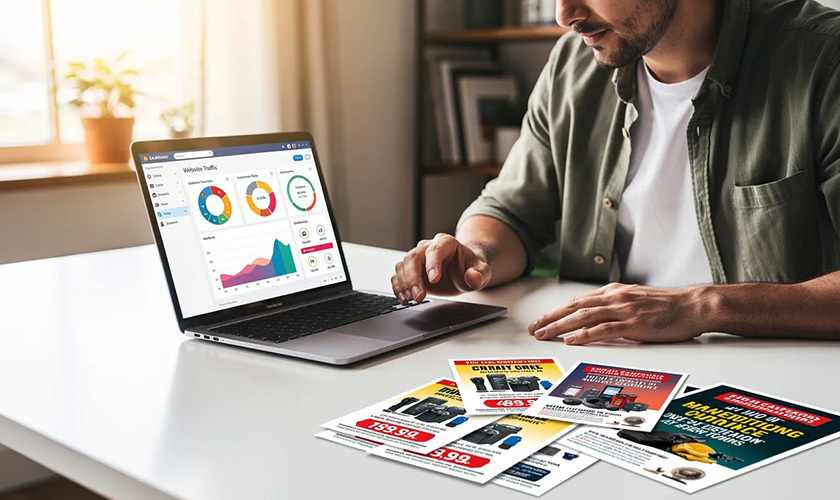
The guidelines below cover audience selection, testing, messaging, quality control, follow-up, and integration with online marketing. Treat direct mail like any performance channel: plan carefully, document assumptions, test systematically, and refine based on data.
Even small improvements in list quality, offer strength, or CTA clarity can significantly improve response and ROI at scale.
Do: Define and Segment Your Audience
Sending fewer, better-targeted pieces usually outperforms blasting large unsegmented lists. A highly targeted direct mail approach reduces waste and increases engagement.
Segment by:
-
Geography: Radius around a store, specific ZIP codes, carrier routes
-
Demographics: Income bands, age groups, homeownership status
-
Behavior: Past purchases, lapsed customers, website visitors, membership status
Create separate segments for distinct audiences. New homeowners receive different messaging than customers with expiring service agreements or high-value repeat buyers.
Document your selection rules so future campaigns can be replicated or improved. Regularly clean lists—removing duplicates, undeliverables, and inactive contacts—to reduce postage waste and improve delivery rates.
Do: Test Before You Scale
Testing and optimizing direct mail campaigns are critical stages in ensuring that marketing efforts deliver the best results, allowing for adjustments based on audience response.
Run small test batches (a few hundred to a few thousand pieces) to validate creative, offers, and targeting before committing to large print runs. This direct mail strategy minimizes risk while generating actionable data.
A/B test key variables:
-
Headlines and images
-
Offers (percentage vs. dollar discount)
-
Formats (postcard vs. letter)
-
Timing (weekday vs. weekend delivery)
Use unique tracking tools for each test variant so performance differences are measurable. Tests should have a clear hypothesis (e.g., “a time-limited offer will increase engagement by 20%”) and be evaluated against specific metrics.
Keep one control version stable across multiple campaigns to benchmark improvements over time.
Do: Include a Clear, Compelling CTA
Every mail piece should have a single, unmistakable call to action that stands out visually and is repeated at least once on the front or back. Ambiguity kills conversions.
Strong CTA examples:
-
“Call 555-123-4567 to book your free inspection”
-
“Scan this QR code to claim your 20% discount”
-
“Bring this card into our store by July 31st 2026”
Use urgency and incentives ethically—limited-time discounts, bonuses, early-bird access—without misleading claims. Ensure contact paths (phone numbers, URLs) are easy to type or scan and are staffed so responses are handled promptly.
Align the CTA with the buying stage. Softer CTAs like “Download our buyer’s guide” work for early-stage potential customers, while “Book now” fits warmer leads ready to purchase.
Don’t: Neglect Proofreading and Compliance
Typos, incorrect prices, or wrong contact details damage credibility and directly reduce response rates. These errors become expensive when printed on thousands of pieces.
Quality control checklist:
-
Multiple review rounds for copy, design, and data
-
Verify personalization fields (names, addresses) render correctly
-
Check that offers, terms, and disclosures comply with local advertising laws
-
Verify address formatting meets postal requirements
-
Test QR codes and URLs before printing
Keep a final proof sample on record for each campaign so any issues can be traced back to the original artwork. For industries like finance, healthcare, or insurance, ensure all required disclosures appear correctly.
Don’t: Forget Follow-Up and Digital Integration
Direct mail works best as the start of a conversation, not a one-off touch that’s never referenced again. Direct mail can be effectively combined with email marketing to reinforce messages, as both channels can share identical themes and offers, increasing brand recall.
Build follow-up sequences—emails, calls, SMS, or retargeting ads—for those who respond and for recipients who visited a landing page but didn’t convert. Using QR codes in direct mail pieces can bridge the gap between physical and digital marketing, allowing recipients to engage with online content directly from their mail.

Synchronize messaging and creative across channels so customers see consistent offers and design, whether they come from mail, email, or ads. Combining direct mail with digital retargeting strategies can create additional touchpoints with potential customers, enhancing the overall effectiveness of marketing campaigns.
Capture responses in a central system and tag contacts with campaign IDs so future communications can reference past offers or interactions. Integrating direct mail with online reviews, social media, and referral programs extends the impact beyond the initial recipient.
Direct Mail Marketing FAQ's
This section addresses common questions businesses ask when deciding whether and how to use direct mail work today.
How often should I send direct mail to the same audience?
Optimal frequency depends on industry and goal, but many businesses see good results mailing key segments every 1–3 months rather than weekly or only once a year.
Start with a quarterly cadence for general relationship-building pieces—seasonal tips, reminders, light offers. Add extra mailings around major promotions or renewals. Monitor opt-out rates, complaint levels, and diminishing response rates as signals that frequency may be too high.
Stagger campaigns so different segments receive different messages at different times. Integrate direct mail touchpoints with email and digital ads so total contact frequency feels coherent rather than repetitive.
Where can I get a good mailing list for direct mail campaigns?
The most valuable mailing lists typically come from your own data: past customers, current subscribers, event attendees, and leads gathered from your website or offline events. These house lists generate the highest response rates.
For prospecting, rent or purchase lists from reputable mailing brokers or data providers, targeting by geography, demographics, or firmographics (for B2B). Vet any external provider on data freshness, consent practices, and accuracy. Test a small portion before large-scale mailings.
Enhance house lists with additional data (property attributes, industry codes) to create more precise segments. Maintain ongoing processes to update addresses using change-of-address services and remove invalid contacts.
Is direct mail effective for B2B as well as B2C?
Direct mail can work in both contexts, but strategies differ significantly.
B2B campaigns typically target smaller, more defined lists of decision-makers with higher-value offers—demos, consultations, workshops—rather than broad discounts. B2B mailers can be more educational (sending printed reports or guides) to support long sales cycles and complex buying committees.
Personalized packages or dimensional mail (small branded items) can be highly effective for reaching high-value B2B accounts. Coordinate mail with account-based marketing tactics like personalized emails, LinkedIn outreach, and targeted display ads.
How can I make my direct mail more environmentally responsible?
Practical steps include using responsibly sourced or recycled paper, vegetable-based inks, and avoiding unnecessary plastic. Precise targeting and clean lists minimize waste by reducing undeliverable or irrelevant pieces—this has the biggest environmental impact.
Consider lighter-weight formats and right-sized pieces to reduce material and postage footprint without sacrificing message clarity. Transparently communicate sustainability choices on the mailer itself to align with environmentally conscious customers.
What budget do I need to start testing direct mail?
Businesses can start with modest budgets by running small test campaigns of a few hundred to a few thousand pieces.
A rough example: a postcard test of 1,000 pieces at around $0.50–$1.00 each (all-in) might require a budget of $500–$1,000. Allocate extra for design and copywriting if in-house expertise is limited, since strong creative significantly influences response rates.
Treat initial campaigns as experiments where the main goal is learning which audiences, offers, and formats work. Reinvest profits from successful tests into larger, refined campaigns over time.
Additional Frequently Asked Questions
How does direct mail integrate with my existing email marketing?
Direct mail and email marketing complement each other when coordinated properly. Many businesses send email sequences before or after direct mail drops, reinforcing the same offer across channels. For example, an email preview can alert recipients to expect something in their mailbox, increasing anticipation and open rates.
You can also use email to follow up with recipients who scanned a QR code or visited a landing page but didn’t convert. This multi-channel direct mail approach creates consistent touchpoints without feeling redundant.
Can I automate direct mail like I do email?
Yes. Modern platforms integrate with CRMs and e-commerce systems to trigger automated direct mail campaigns based on customer behavior. Common triggers include cart abandonment, birthday milestones, post-purchase thank-yous, and subscription renewals.
These automated workflows bring the responsiveness of digital marketing to physical correspondence, delivering timely, relevant mail without manual intervention.
How long does it take to see results from a direct mail campaign?
Typical direct mail campaigns show initial responses within 1–2 weeks of delivery, with most responses coming within the first month. However, some recipients hold onto pieces longer, so continue tracking for 4–6 weeks after delivery.
Build this timeline into planning: if you need appointments booked for a June event, mail should reach recipients by mid-May at the latest.
What makes someone throw away direct mail versus respond to it?
The difference usually comes down to relevance and value. Generic, untargeted pieces that offer nothing compelling get discarded quickly. Mail that speaks to a specific need, offers genuine value, and makes responding easy gets action.
Consumers are likely to open or read a direct mail piece with an offer or promotion, highlighting the effectiveness of personalized offers. Invest in targeting and offer development rather than just design aesthetics.
Direct Mail Marketing Summary
Modern direct mail marketing combines the tactile power of physical correspondence with data-driven precision that rivals any digital channel. While digital advertising continues to grow more crowded and expensive, direct mail offers a path to customer engagement that stands apart from the digital space entirely.
Start with a small test campaign, perhaps 1,000 postcards to a well-defined segment. Measure results carefully using tracking codes and dedicated response paths. Use what you learn to refine your direct mail strategy and scale what works.
The businesses seeing the best returns treat direct mail as one component of an integrated marketing strategy, connecting print to digital touchpoints and building relationships that extend far beyond a single mailer. Whether you’re looking to increase engagement with existing customers or reach new potential customers in your area, direct mail delivers results that justify its place in your marketing efforts.
(678) 235-3464
To view the original version on Clash Graphics, visit: https://www.clashgraphics.com/printing-tips/what-is-direct-mail-marketing/
